Running OpenTelemetry as a CLI application
Configure the OpenTelemetry Collector to send logs and host metrics to Coralogix when you run it directly (as a CLI binary or as a service) rather than in a cluster.
What you need
- The Collector installed. It must be opentelemetry-collector-contrib, not the core distribution, the Coralogix exporter ships only in contrib. Download a build for your OS from the releases page.
- A Coralogix Send-Your-Data API key.
- Your Coralogix domain.
Configure the Collector
Save this as config.yaml. It tails a log file and scrapes CPU and memory, then exports both to Coralogix.
receivers:
  filelog:
    start_at: beginning
    include:
      - /example.log
    include_file_path: true
    multiline: {line_start_pattern: "\\n"}
  hostmetrics:
    collection_interval: 30s
    scrapers:
      cpu:
      memory:
exporters:
  coralogix:
    domain: "eu2.coralogix.com"
    private_key: "Private key"
    application_name: "Application Name"
    subsystem_name: "Subsystem Name"
    application_name_attributes:
      - "cx.application.name"
    subsystem_name_attributes:
      - "cx.subsystem.name"
    timeout: 30s

service:
  pipelines:
    logs:
      receivers: [ filelog ]
      exporters: [ coralogix ]
    metrics:
      receivers: [ hostmetrics ]
      exporters: [ coralogix ]
| Value | What to enter |
|---|---|
private_key | Your Coralogix Send-Your-Data API key |
domain | Your Coralogix domain |
application_name | The application name shown in your dashboard. A company called SuperData might use SuperData, or SuperData-Test for a test environment |
subsystem_name | The subsystem name shown in your dashboard. Most applications have several (backend servers, middleware, frontend servers) and this is what lets you separate them later |
Save this as example.log, so there is something for the filelog receiver to pick up.
2023-06-19 05:20:50 ERROR This is a test error message
2023-06-20 12:50:00 DEBUG This is a test debug message
2023-06-21 12:34:56 INFO This is a test info message
Use the form that matches your installation.
# Installed as an application
./otelcol-contrib --config config.yaml

# Installed as a service
otelcol-contrib --config config.yaml
Validate the logs
In Coralogix, select LiveTail, then Start. The three test lines arrive as structured records under the application and subsystem names you configured.
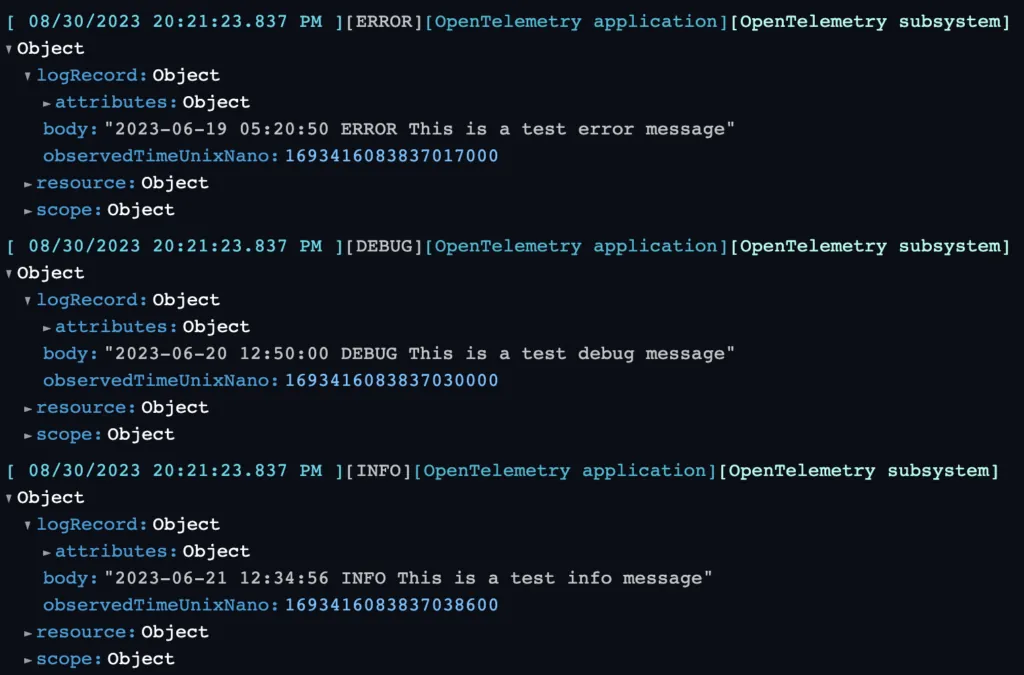
Shows the test file's error, debug, and info lines as they arrive.
Validate the metrics
In the left-hand panel, select Explore, then Metrics browser, and select a metric. The host metrics receiver produces system_cpu_time_total and system_memory_usage_By.
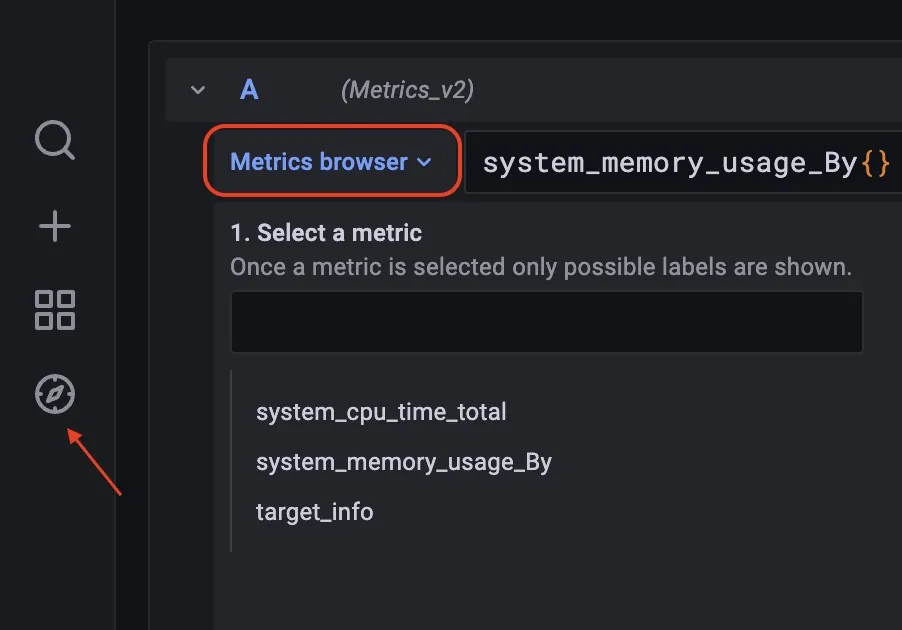
Shows the CPU and memory series the hostmetrics scrapers emit.