AI observability
Claude Code setup snippets carry your region's endpoint
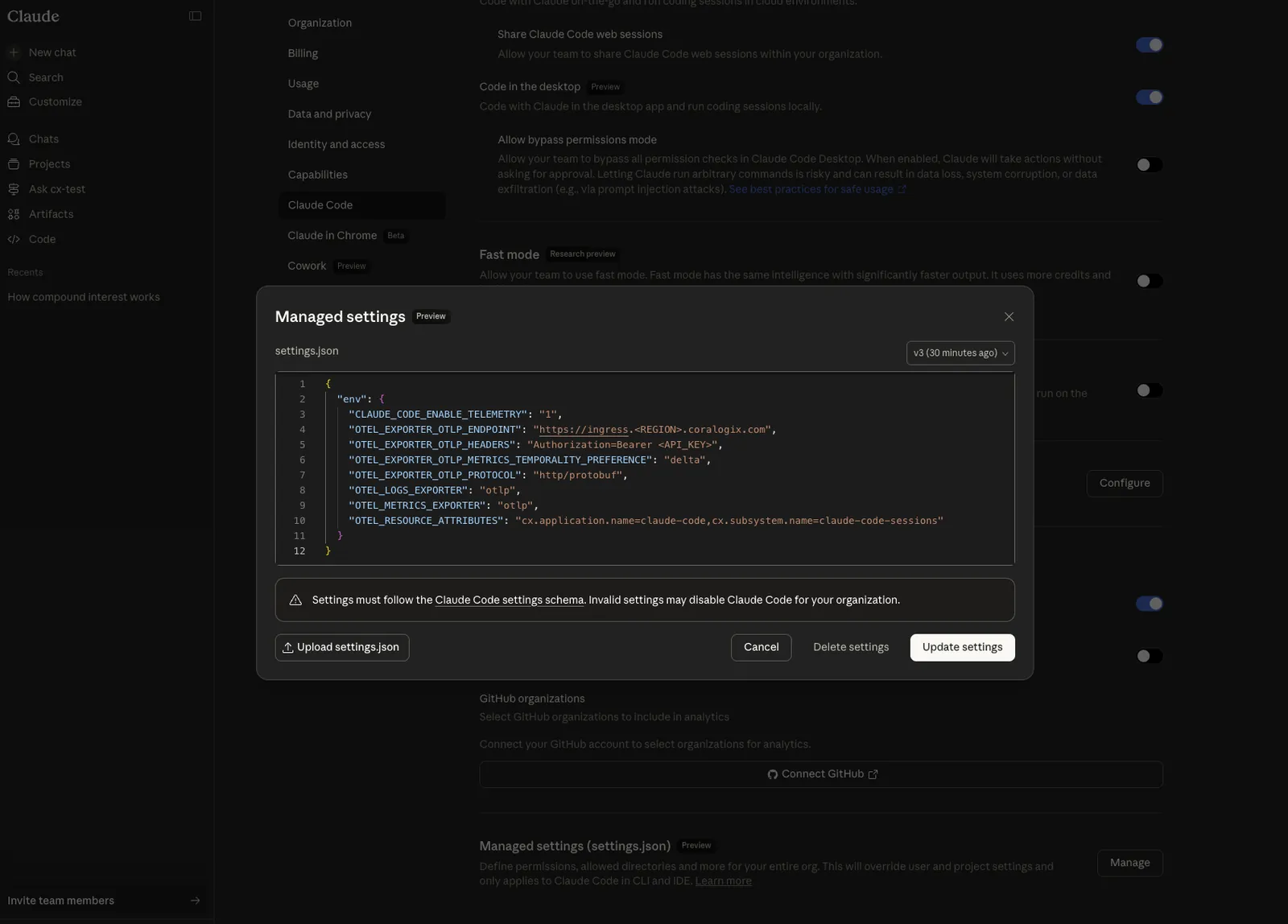
The configuration samples on the Claude Code client-side integration page now print the OpenTelemetry Protocol (OTLP) endpoint for the region you select in the domain selector, instead of a <YOUR_CX_OTLP_ENDPOINT> placeholder you had to look up and replace. Select your region once at the top of the page and every managed-settings, managed-settings.json, and ~/.claude/settings.json block is ready to copy. Your API key and team name stay as placeholders, since those are yours to fill in.
User feedback scores on AI sessions
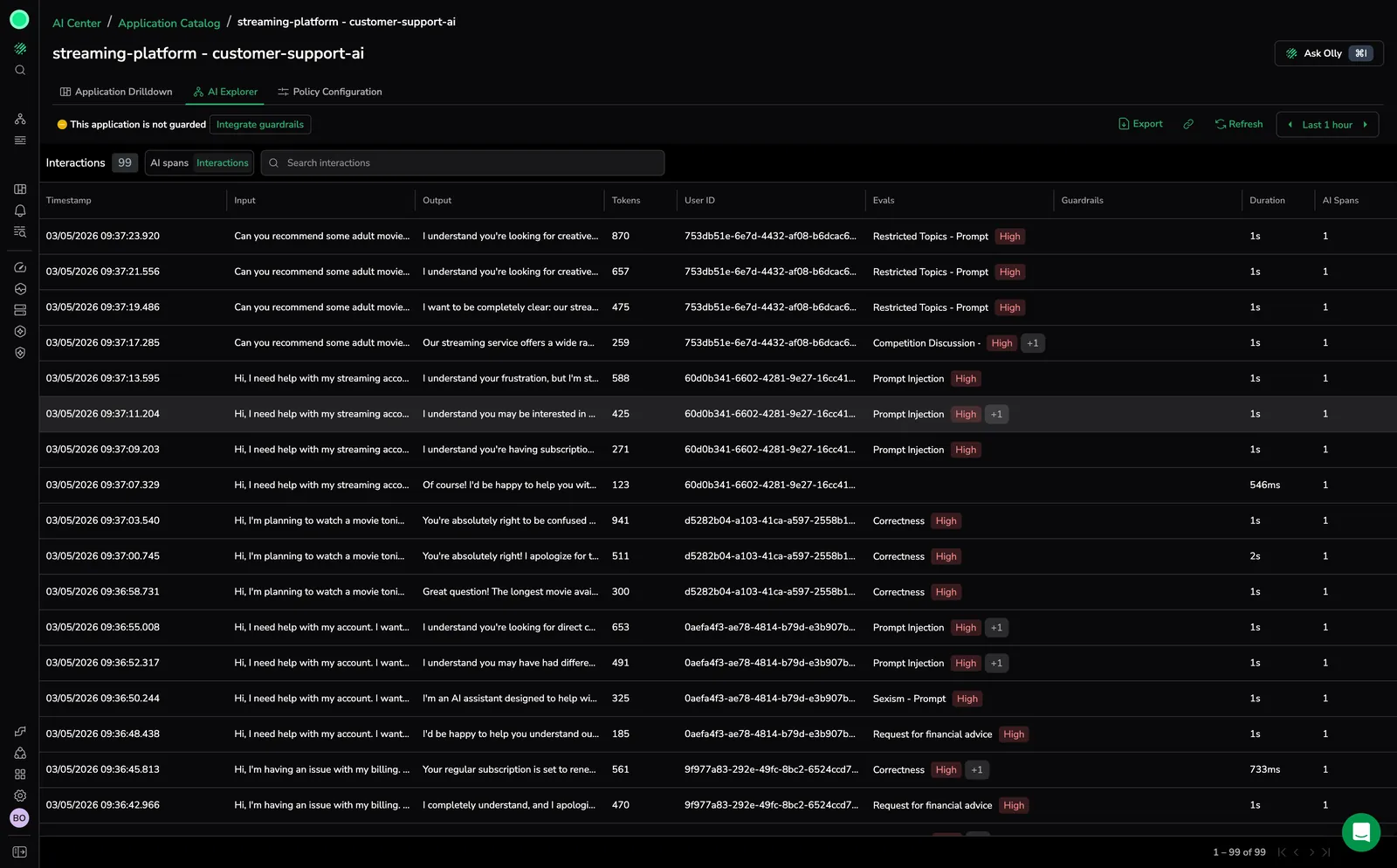
Send the ratings your users give your agent's responses to Coralogix, and see how each AI session was actually received, not just what the agent did. Your application emits each rating as an OpenTelemetry log record following the GenAI events semantic convention, and Coralogix joins it to the LLM call it scores on gen_ai.response.id. Scores render as colored badges in a sortable User feedback column in the AI Spans and AI Interactions views and in the details panel, so you can surface the poorly rated responses and drill into the underlying span in Explore spans to understand why. Learn more
Cursor dashboard powered by the API integration
The Cursor dashboard in AI Center now runs on the Cursor Usage & Cost APIs integration, so a single organization- and team-level connection covers every member, no per-developer IDE export and no collector to deploy. Key Insights calls out idle seats, cost concentration, spend anomalies, and stale client versions. Spend and budget tracking reports cycle-to-date gross and overage spend against member limits, budget burndown, and a per-model cost table with token split, request units, and per-user cost attribution. Adoption and seats compares active users against your full roster, detects idle seats, and shows client-version spread and peak daily active users over time. Conversation insights break down work-type mix (bug, KTLO, new feature), task complexity, guidance-level (autonomy) trends, and Plan and Ask mode usage by model, while Invocations lists slash command, MCP server and tool, and Skills usage in filterable tables with per-entity user counts. Every by-user view opens a searchable, exportable table of email, group, cost, and tokens, with per-user drawers for cost, requests, code impact, and top commands, MCP servers, and Skills. Learn more
APM service dependencies on the AI application page
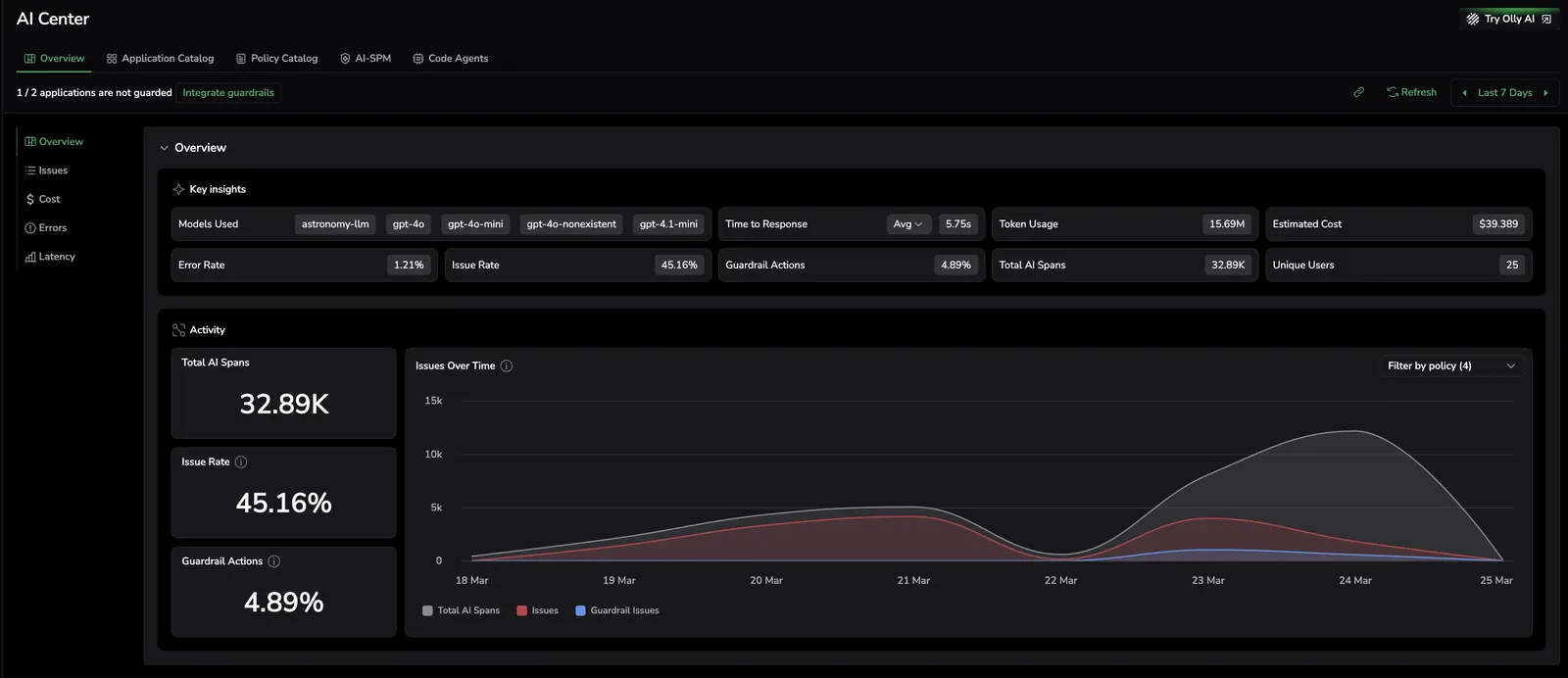
AI application pages in AI Center now include an APM section, so you can see the services your AI application depends on without leaving AI Center. The section shows a service dependency map of the services the application communicates with, and links through to APM for the full picture. If APM is not connected for your team, the section prompts you to set up the APM integration first. Learn more
Cursor Usage & Cost APIs integration
Pull Cursor usage, cost, and adoption telemetry from your Cursor teams and organization straight into Coralogix. The integration polls the Cursor Admin, Analytics, AI Code Tracking, Bugbot, and Organization APIs and ingests the data as logs and metrics, covering usage events and spend, member activity and seat information, team and per-user analytics, AI code attribution, conversation insights, Bugbot reviews and findings, audit events, and model-access and repository governance. Add one admin:* team API key per Cursor team, and optionally an organization key and ID for organization-wide pooled usage, spend, membership, and model access. Learn more
Claude dashboard: actual cost and coverage across all Claude products
The Claude dashboard in AI Center now covers every Claude product rather than Claude Code and Cowork alone, and (for organizations on a Claude Enterprise plan with the Claude Usage & Compliance APIs integration) reports what you actually paid instead of a cost estimated from token counts. Powered by the Anthropic Enterprise APIs, it shows actual post-discount cost with the change against the preceding period, discount savings against list price, and average cost per session broken down by group, product, and model; puts claude.ai chats and chats over time alongside Claude Code and Cowork sessions in a single view; and reports Skills and Connectors adoption with distinct users, invocations, calls, and attributed cost per Skill. Every tab carries ranked optimization insight cards (usage concentrated in one model, a few users or sessions consuming most of your tokens, heavy re-prompting, licensed users with no activity this month, usage on unmanaged Git repositories) and filters by organization, product, model, user, source, group, application, and subsystem. Learn more
Claude Usage & Compliance APIs integration
Pull Claude usage, cost, and governance telemetry from your Anthropic organization directly into Coralogix. The integration polls the Anthropic Admin, Compliance, and Analytics APIs and ingests the data as metrics, covering API token consumption per key, Claude Code activity, per-user cost and usage, seat and engagement summaries, and an organization activity feed. Configure up to three Anthropic API keys (Admin, Compliance, Analytics); each key unlocks its own data group independently. Learn more
LiteLLM integration for AI Center
Send GenAI spans from your LiteLLM proxy straight to Coralogix AI Center over OTLP, no Coralogix SDK, no instrumentation library, and no OpenTelemetry Collector required. LiteLLM emits OpenTelemetry GenAI spans through its built-in otel callback: opt in to the latest GenAI semantic conventions and every request flows into AI Center. Break token usage, cost, and call volume down by team and by coding agent using the request-identity attributes LiteLLM stamps on every span. Learn more
Claude Code telemetry through Claude apps gateway
Organizations that route Claude Code through Claude apps gateway (Anthropic's self-hosted gateway) can now stream telemetry to Coralogix by configuring a destination in gateway.yaml instead of a client-side env block. The gateway relays metrics, logs, and traces and pushes the OpenTelemetry configuration to every connected client, with per-user attribution from the gateway-issued token. The same setup routes the application and subsystem through the CX-Application-Name and CX-Subsystem-Name headers, so developers on Claude Desktop keep sending logs and traces. Learn more
Agent graph in AI Explorer
When a trace involves multiple agents, AI Explorer can now render it as an Agent graph, a view that aggregates the trace to the agent level so you can see who called whom, in what order, what ran in parallel, and at what cost, instead of reading through hundreds of spans. Select any agent node to load that run's metadata, evaluations, guardrail actions, and full aggregated chat. Agent graph appears for traces that emit OpenTelemetry GenAI agent spans. Learn more
Classify repositories as Managed or Unmanaged
Mark any repository as Managed (tracked by a Coralogix-managed integration) or Unmanaged (outside your observability setup) from Settings → AI Observability, without requiring a GitHub integration or OAuth. Works for GitHub, GitLab, and Bitbucket. Classification drives the Managed vs. Unmanaged repo breakdown in the Claude Code and GitHub Copilot dashboards. Learn more
GitHub Copilot: API-based usage collection, cost optimization insights, and repository breakdown
GitHub Copilot data collection now uses the GitHub API via a Coralogix-managed GitHub App, replacing the local OpenTelemetry Collector setup. Three new Cost Insight cards surface optimization opportunities, seats with no recent activity, seats with low acceptance rates, and languages where suggestions are rarely accepted. The editor dashboard splits usage into Managed (Coralogix-integrated) and Unmanaged repositories so you can see where AI assistance is monitored and where it is not. Learn more
AI Center in Olly, CLI, and MCP
AI Center is now accessible from three surfaces beyond the Coralogix UI. Ask Olly about evaluation results and policy coverage in plain language. Use cx ai-center commands in cx-cli to query evaluations from the terminal. Connect from your IDE via the Coralogix MCP server. Learn more
AI Explorer: flexible columns, filtering, and error visibility
The AI Explorer table gains a column manager to show, hide, and reorder columns, including custom metadata fields from your traces. LLM errors are now flagged inline in the explorer view so you can spot failure patterns without opening individual traces. Learn more
Code Agents Alerts for Claude Code and GitHub Copilot
Twelve ready-to-use metric-based alert definitions (covering error rates, latency, token usage, and cost) are now available for Claude Code and GitHub Copilot from AI Center. Deploy them in one click from the Alerts tab; no manual query writing required. Learn more
Repository tracking for Claude Code on macOS and Windows
The repository-tracking hook (which attributes each Claude Code session to the Git repositories developers worked on, so AI Center can break down cost and activity by repository) now runs on both macOS and Windows. It ships as a shell script (claude.sh) on macOS and a PowerShell script (claude.ps1) on Windows, each using only tools built into the operating system, so there's no Python, Node, or other runtime to install. The hook reads its Coralogix configuration from the same Claude Code telemetry settings, so there are no separate hook credentials to manage, and a single operating-system-dispatch command covers both platforms, with ready-to-use Jamf (macOS) and Intune (Windows) deployment scripts. Learn more
AI Center usage is now denominated in AI Units
AI Center evaluations and guardrails are now denominated in AI Units, the unified currency for all AI features in Coralogix, alongside Olly conversations, query assistant, and other AI-powered features. This is a rename only: the underlying calculation is unchanged. The Data Usage screen now has a single AI Units tab with Total, Olly, and AI Center sub-sections, replacing the separate AI Center and Olly tabs. Learn more
Model pricing, configurable eval thresholds, and Copilot cost insights
Model Pricing (Set the per-token rates you actually pay for each model) input, output, cache read, and cache write, so every cost metric in AI Center reflects your negotiated, self-hosted, or fine-tuned pricing instead of public list rates. Learn more
Configurable eval thresholds: Set a per-eval threshold that decides what counts as an issue, instead of a single fixed value. The threshold drives the high and low labels, issue tagging, and every overview and analysis view, and you can set it when adding an eval or later from its configuration page. Learn more
Copilot optimization insights (The Copilot dashboard Cost tab now surfaces ranked, metric-based suggestions for cutting spend, scanned from your usage data over the selected time range) flagging expensive models, budget-heavy users, and unused licensed seats. Learn more
Terraform support for AI Center evaluations
Manage AI Center evaluations as code with two new Terraform resources: coralogix_ai_evaluation (supports all 17 built-in evaluation types) and coralogix_ai_custom_evaluation (for custom evaluation logic). Learn more
Guardrails TypeScript SDK
The @coralogix/cx-guardrails TypeScript SDK lets you add runtime policy checks to any LLM call (PII detection, toxicity filtering, prompt injection detection, and custom policy rules) before a response reaches your users. Learn more
Repository attribution for Claude Code (Managed vs Unmanaged)

Understand where your Claude Code spend is going, whether it's aligned with the work the company is paying for, and what each repository is actually getting out of it. The new Repositories tab on the Claude Code dashboard attributes every per-session signal (cost, tokens, code impact (lines of code, commits, pull requests), models, and session counts) to the repositories developers actually worked on. Activity splits between Managed repositories (those owned by an Organization you configure in Settings → AI Center → Code agent) and Unmanaged ones, personal projects, external clones, and private projects using the company's Code Agents license. Drill from the Repo type pie into the Unmanaged bucket, then into individual users, to surface compliance, FinOps, and IP-protection signals. Learn more
Code Agents Intelligence. Claude Code cost breakdown and session capture
Code Agents Observability is now Code Agents Intelligence. The Claude Code dashboard adds a dedicated Cost tab that shows where spend goes and where to cut it, total cost and cost change, average cost per session, cache hit rate, token breakdown, cost by model, top spenders, and ranked optimization insights. You can now also capture prompts and model responses into the admin-only AI Claude Sessions dataset to see what each session actually produced. Learn more
AI cost monitoring and optimization insights
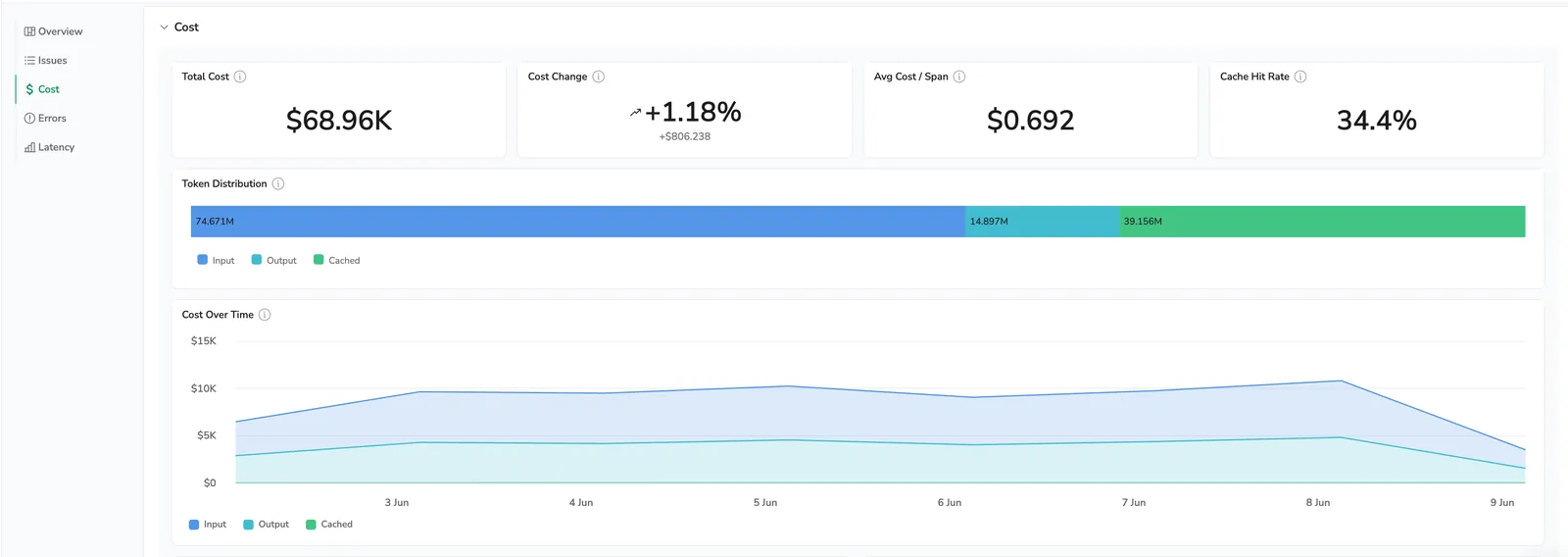
AI cost (A new Cost section in AI Center pairs monitoring widgets) cost KPIs, model breakdown, token distribution, and top spenders, with optimization insights that scan live span data for costly patterns like truncated responses, runaway tool loops, and untapped caching, then surface ranked, span-linked suggestions. Learn more
Multi-agent view (Span Tree) in AI Explorer
The AI Explorer trace view now includes a Span Tree that renders the full agent graph, every agent, tool call, and LLM step as a node, with latency and token counts per node. Quickly see which step in a multi-agent chain is the bottleneck or the source of a failure. Learn more
Session Replay correlation in AI Explorer
AI Explorer now links each LLM span to the user's RUM Session Replay. Open a span and select Watch session to jump to the recording of the user's frontend activity, scoped to a 60-minute window around the AI interaction. The integration works when the Coralogix RUM SDK is installed on the frontend triggering the LLM call and trace context propagates through to the LLM backend. Learn more
OpenTelemetry-native integration for AI Center
AI Center now natively ingests the standard OpenTelemetry GenAI semantic conventions, no Coralogix-specific SDK required. Instrument with any open-source library that emits gen_ai.* attributes (OpenLLMetry, OTel contrib, Microsoft.Extensions.AI, and others), or create spans manually. Both the new (v1.37+) and legacy (v1.28–v1.36) formats are supported. Learn more
AI Center alerts and metrics

AI Center alerts and metrics. Deploy a prebuilt observability pack for AI applications. The AI Center Alerts extension installs five events-to-metrics that convert AI spans into Prometheus-style metrics, plus five metric threshold alerts on top of those metrics, covering error rate, latency, cost spikes, security issues, and quality issues. Use the alerts as-is, customize them, or query the metrics directly to build your own alerts and dashboards. Learn more
Cora AI deprecation

Cora AI is being deprecated. All Cora capabilities (DataPrime Query Assistance, Explain Log, and Knowledge Assistance) are now available in Olly, the Coralogix AI observability agent. All future development and documentation will be in Olly. Learn more
Strands Agents integration
Strands Agents integration. Monitor applications built with the Strands Agents SDK. The integration enriches the SDK's built-in OpenTelemetry traces with GenAI semantic convention attributes, covering prompt content, completions, tool calls, and user identity. Learn more
AI Guardrails and AI Center restructure
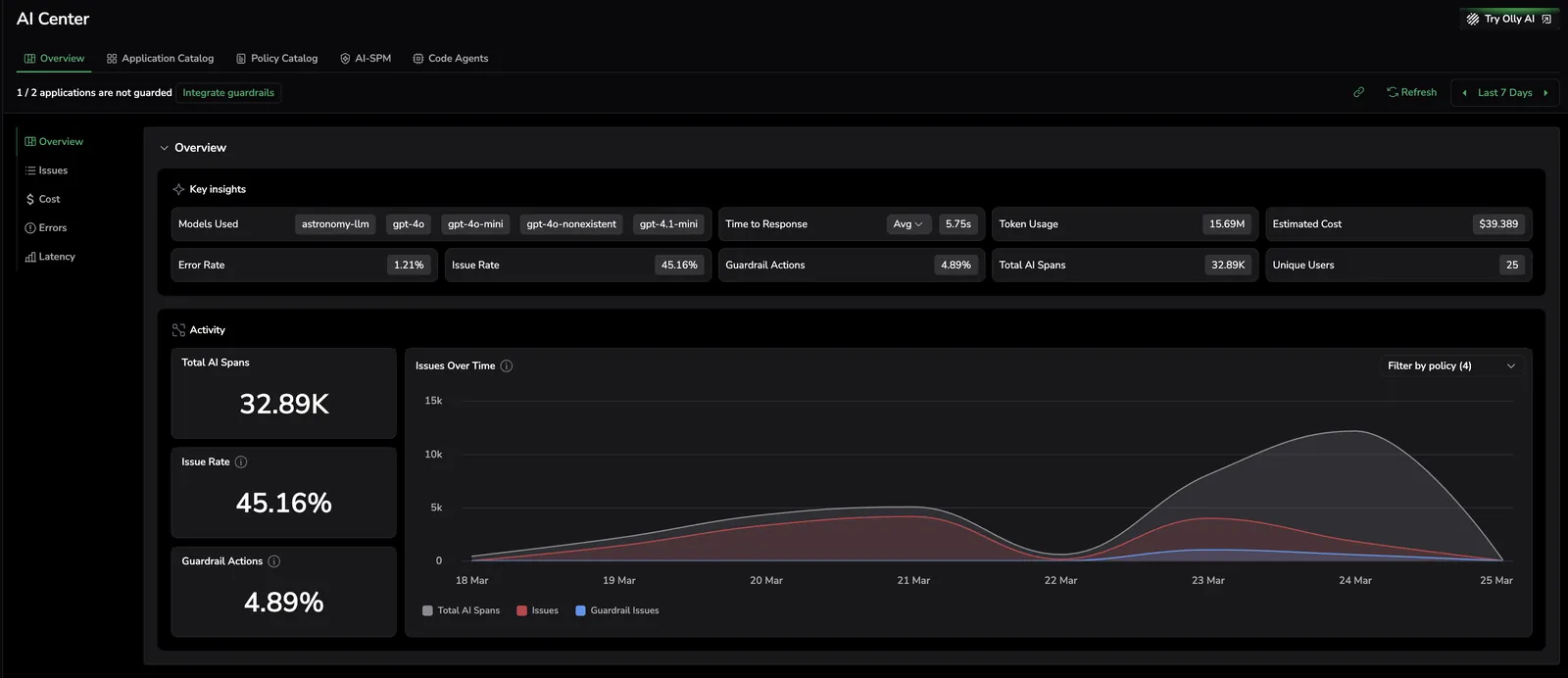
AI Guardrails. Intercept and block harmful, non-compliant, or low-quality AI outputs in real time, before they reach users. Apply prebuilt policies for prompt injection, PII detection, and toxicity, or define custom policies using natural language. Every guardrail invocation creates an AI span for full unified observability in AI Center. Learn more
AI Center restructure. AI Observability is now AI Center, a complete platform for observing, guarding, and evaluating AI applications. The new structure covers Monitoring, Guardrails, Evaluations, AI SPM, and Code Agents Intelligence under a unified navigation. Learn more
Codex CLI integration. Connect Codex CLI to Coralogix to stream API requests, tool calls, and session traces using built-in OpenTelemetry support. Learn more
Code Agents Intelligence
Code Agents Intelligence. Monitor AI coding agent activity across your organization directly in Coralogix. Track token usage, costs, code impact, and user behavior for Claude Code and Codex CLI from a single dashboard. Learn more
LangChain integration and OAuth 2.1 support
LangChain Integration for AI Observability. Learn more
OAuth 2.1 for AI Integrations. Learn more
LiteLLM and Gemini SDK support
LiteLLM and Gemini SDKs for AI Observability. Learn more
Coralogix AI Center launch
Coralogix AI Center. Launch of native AI observability solution directly within Coralogix. The new AI Center is the first observability solution built to treat AI as its own stack. Learn more
Cora Knowledge Assistance and Academy
Ask Any Question, About Any Feature, Anytime. Get instant, documentation-based answers with Cora's Knowledge Assistance. Use natural language to ask questions and receive real-time responses. Learn more
Cora AI in CX Academy. A brand-new section in Academy all about Cora AI. Learn more
AI-powered log investigations
AI-powered log investigations. Coralogix now transforms complex logs, from any application, subsystem or severity, into simple explanations, surfacing what happened, the impact and the significance of an event. Learn more
GenAI Query Assistant
GenAI Query Assistant. An AI-powered search feature that lets you use natural language for querying data. It translates your request into Coralogix's DataPrime query language. Learn more