

Threat Advisory - Java4Shell: OpenJDK Base64 Pre-Auth RCE
Snowbit advisory on Java4Shell (CVE-2026-114938), a pre-auth RCE in OpenJDK's Base64 decoder: who is exposed, fixed Java builds, workaround and remediation.
Threat Detection & Response Team5 min read
Executive Summary
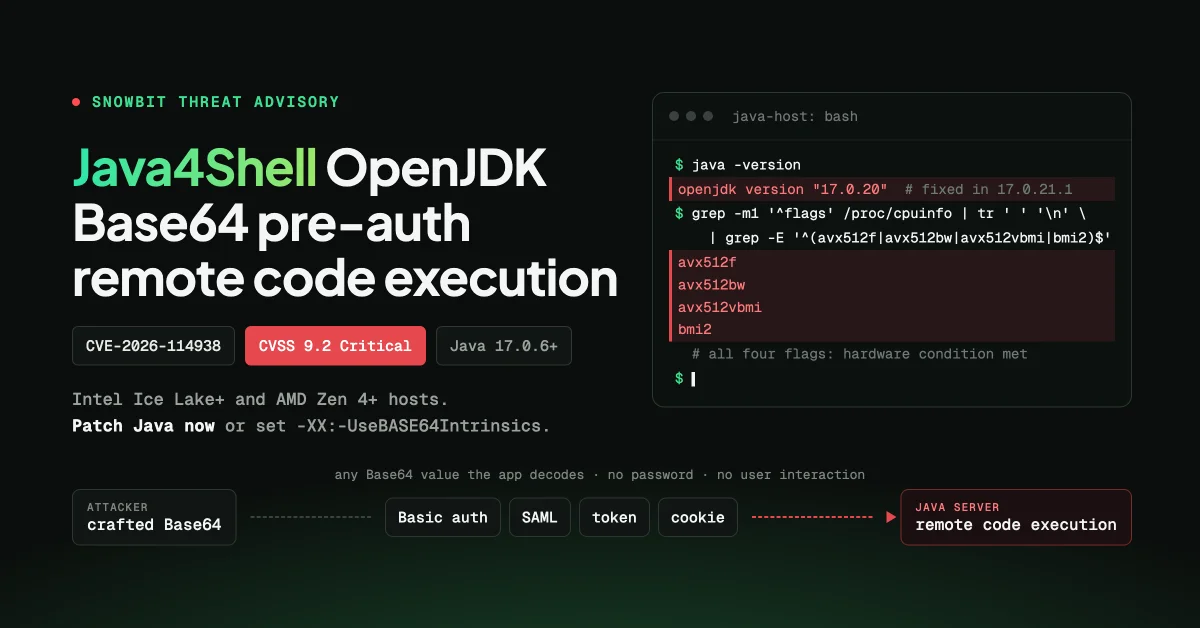
On November 17, 2026, security researchers at Calif disclosed a serious flaw in Java, named Java4Shell (CVE-2026-114938). By sending a specially crafted piece of text, an attacker can take control of a server running Java without needing a password. The researchers showed this working against Jenkins, Jira, Confluence, Keycloak, Artifactory and PingFederate in their default settings. It is rated critical: 9.2 (CVSS 4.0) by Calif, and 8.1 (CVSS 3.1, high attack complexity) by Oracle.
The problem is in Java itself, so any application built on it could be at risk. Three things must be true together: the server runs Java 17.0.6 or newer without the latest patch, it uses a recent Intel or AMD processor (Intel Ice Lake or newer, AMD Zen 4 or newer), and an attacker can send data to the application. This applies whatever the operating system (Windows, Linux or Intel-based Mac). ARM chips, including AWS Graviton and Apple Silicon, and older processors are not affected.
No attacks have been reported so far. Calif has published a proof of concept that triggers the flaw but does not take control of a system. Others are already building exploits: Wiz built one with AI tools in about two hours, and Immersive says it has one that needs adapting to each application. Treat this as urgent. Install the latest Java update now. If you can't patch straight away, switch off the affected feature with the Java setting -XX:-UseBASE64Intrinsics until the update is in place.
How It Works
- Delivery: The attacker sends any Base64 value the app decodes: a Basic credential, SAML message, token or cookie.
- Intrinsic selected: On CPUs with AVX-512 VBMI, C2 swaps
Base64.Decoder'sdecodeBlock()for a vectorized intrinsic. Only the basic and URL decoders reach it; the MIME decoder does not. - Length underflow: For a padded tail such as
=,==,X=orXY=, the tail handler computes an output length of -1 or -2 without checking the sign. - Oversized write:
BZHIbuilds a store mask from that length, all 64 bits end up set, andevmovdqubwrites 64 bytes instead of the intended few. Calif measured writes reaching 62 bytes past the end of the array. - Outcome: Depending on heap layout the attacker gets a JVM crash, a heap read Calif calls JavaBleed, or code execution. Catching the exception does not undo the corruption.
Who is exposed
| Condition | Exposed | Not exposed |
|---|---|---|
| Java runtime | Unpatched OpenJDK-based builds from 17.0.6 (17, 21, 25, 27), any vendor; Oracle Java SE 8 Enterprise Performance Pack 8u511b33-perf | Not reported as affected: OpenJDK 17.0.0 to 17.0.5, standard Java 8 and 11. Oracle notes earlier versions may also be affected, so upgrade regardless |
| CPU | x86-64 reporting avx512f, avx512bw, avx512vbmi and bmi2: Intel Xeon Ice Lake to Granite Rapids, AMD Zen 4 and newer (AWS m6i/c6i/r6i, m7i/c7i/r7i, m7a/c7a/r7a, m8a/c8a) | ARM64 (Graviton, Ampere, Apple Silicon); Skylake and Cascade Lake (m5/c5); AMD Zen 3 and older (m6a/c6a) |
What else a vulnerable JDK puts at risk
- Post-auth targets: Remote code execution in Apache Kafka brokers, Apache Solr, Elasticsearch, Gerrit and Spinnaker once authenticated, and in sample Apache Struts and Spring Boot apps.
- Java as a client: A Java program that opens a TLS connection to a malicious server is also exploitable, so integrations, webhook senders and build agents that call untrusted hosts count even if they listen on nothing.
- Memory disclosure without RCE: JavaBleed reads heap memory, which can hold session tokens, passwords and keys.
- Denial of service: A crash is the easiest outcome to reach; crashing an identity provider takes down every app behind it.
- Hidden runtimes: Every downstream OpenJDK build is affected (Corretto, Temurin, Zulu, Liberica, SapMachine, Red Hat, Microsoft, GraalVM), including JREs bundled in appliances and container images that package inventories miss.
Timeline
| Date & Time (UTC) | Event |
|---|---|
| 2026-11-17 | Calif discloses Java4Shell with a trigger PoC; product exploit chains withheld |
| 2026-11-17 21:00 | Oracle November 2026 Critical Security Patch Update ships fixed Java SE builds; Amazon releases Corretto 17.0.21.1.2 |
Key Affected Packages
Fixed builds below are Oracle's. Other vendors ship on their own schedules; confirm their release notes name CVE-2026-114938 before closing a ticket.
| Key Affected Package | Vulnerable Versions | Safe Version |
|---|---|---|
| Java 17 (all OpenJDK builds) | 17.0.6 up to 17.0.21 | 17.0.21.1 (Corretto 17.0.21.1.2) |
| Java 21 | Before 21.0.13.1 | 21.0.13.1 |
| Java 25 | Before 25.0.5.1 | 25.0.5.1 |
| Java 27 | Before 27.0.1.1 | 27.0.1.1 |
| Oracle Java SE 8 Enterprise Performance Pack | 8u511b33-perf | 8u513-perf |
| Standard OpenJDK 8 and 11 | Not reported as affected | N/A |
Remediation
If you suspect your environment or packages have been affected, follow these steps:
- Check the CPU: A Linux host meets the hardware condition only if all four flags print:
grep -m1 '^flags' /proc/cpuinfo | tr ' ' '\n' | grep -E '^(avx512f|avx512bw|avx512vbmi|bmi2)$' - Inventory runtimes: Run
java -versionon every host and image, and include bundled JREs. For a running process usejcmd <PID> VM.version. - Patch: Move to the fixed builds above, rebuild container images on patched base images, then restart every Java process. An installed package does not fix a JVM that is still running.
- Interim workaround: Start x86-64 JVMs with
-XX:-UseBASE64Intrinsics(Base64-heavy workloads may slow down) or-XX:UseAVX=2(wider performance cost). Never setUseAVXon ARM64 JVMs: they refuse to start. Confirm withjcmd <PID> VM.flags -all. - Prioritize: Internet-facing identity providers, CI/CD and collaboration servers first, then internal Kafka, Elasticsearch and Solr. A proxy is no substitute: the trigger is 65 bytes, and Calif reports nginx buffering does not stop the Elasticsearch chain.
Snowbit Response
- Customer environment scanning: Snowbit is monitoring SRC customer environments for CVE-2026-114938. Logs alone can’t confirm whether a system is affected, because they don’t show Java versions or processor types. We are also tracking the wider threat landscape for this vulnerability. If exploitation is reported in the wild, a working exploit is published, or indicators of compromise (IOCs) are released, we will hunt for them across your environment. If we find any related activity, we will raise a Zendesk ticket to let you know.
- Advisory distribution: Being distributed to all Snowbit managed customers; updated as vendors confirm fixed builds.
We strongly recommend all customers inventory every Java 17.0.6+ runtime on x86-64 hosts now, patch to the fixed builds or apply -XX:-UseBASE64Intrinsics, and restart the affected JVMs.
Reference
Keep reading
 Security advisoryThreat Advisory - ClickHouse CVE-2026-116366: Unauthenticated Remote Code ExecutionSnowbit advisory on ClickHouse CVE-2026-116366 (unauthenticated RCE): fixed versions, bundled instances, remediation and DataPrime hunting queries.
 Security advisoryThreat Advisory - Trojanized Claude Code Extension: SSH BackdoorSnowbit advisory on the trojanized Claude Code extension 2.1.313 on Open VSX: how the SSH backdoor works, IOCs, hunting queries and remediation steps.
 Security advisoryeMudhra - Coralogix Full Upgrade Guide