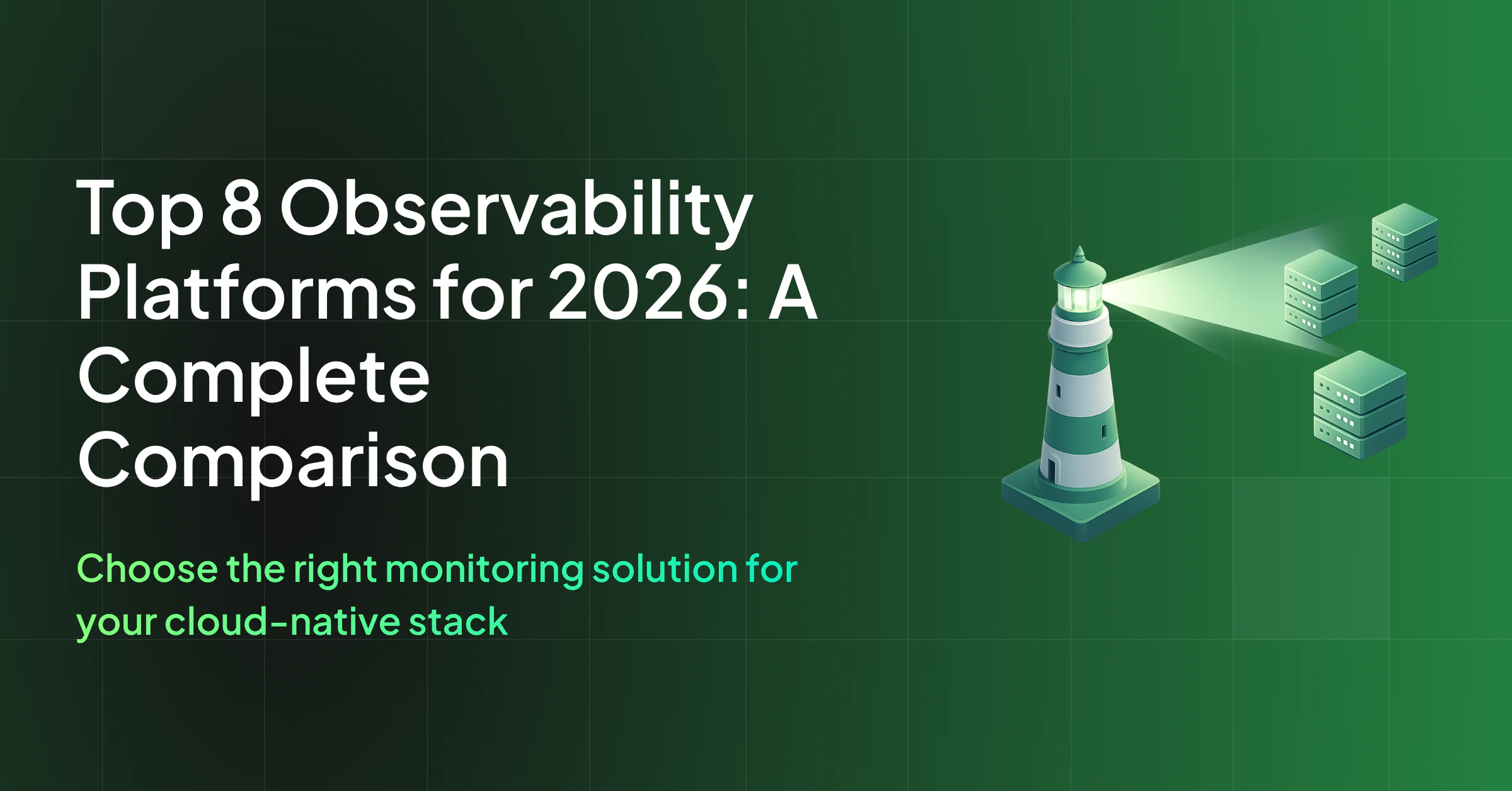
Top 8 Observability Platforms for 2026: A Complete Comparison

Picking an observability platform in 2026 finally feels like a buyer’s market. OpenTelemetry has neutralized agent lock-in, customer-owned storage has moved from a niche feature into a buying criterion, and AI-native investigation has crossed from research demos into production runbooks. The right platform for your team depends less on a feature checklist than on which of those shifts your architecture actually needs.
Below you’ll find the eight platforms worth shortlisting in 2026, scored on the criteria that actually settle a comparison. The rest of this guide covers what’s changed in the market, what to test against your real workload, where each platform fits best, and how to match your shortlist to your stack.
What’s Changed in the Observability Platform Market
Three architectural shifts are reshaping how teams pick a platform in 2026. None of them are about new features; they’re about who owns the data, who pays for the cardinality, and who writes the queries during an incident.
OpenTelemetry Killed Agent Lock-In
OpenTelemetry (OTel) is now widely adopted for cloud-native telemetry collection. Teams used to tolerate proprietary agents as a switching cost, but OTel-native ingestion has pushed every major vendor to accept the OpenTelemetry Protocol (OTLP) directly. You can fan out telemetry to two backends through one Collector and let real traffic settle a comparison.
Customer-Owned Storage Is Becoming Standard
Storing telemetry inside a vendor’s proprietary index is what kept switching expensive. A growing class of platforms now writes data to your own Amazon Simple Storage Service (S3) or Google Cloud Storage bucket in open Parquet format, so retention runs at object-storage prices and the data stays queryable independently of the vendor.
Cost Structure Is the Deciding Factor Once You Grow
Per-host, per-seat, and per-query pricing all break in different ways once you scale beyond a few hundred services. Ingest-priced models with no per-host or per-user fees keep cost predictable as new services come online, which is why teams are modeling at two and five times current data volume before signing.
AI-Native Investigation Is Moving from Demo to Default
Natural language querying and autonomous investigation agents have pushed past the pilot stage. The platforms that integrate AI deeply into the investigation workflow are pulling ahead on mean time to resolution (MTTR), with engineers asking “what changed in checkout in the last hour” instead of writing the query by hand.
How to Evaluate Observability Platforms
The strongest evaluations test a tool against your own traffic, not against a vendor feature matrix. Five criteria separate a real upgrade from a lateral move on the spec sheet:
- Pricing model and total cost of ownership: Model cost at two, five, and 10 times your current data volume, with retention, user seats, and query quotas modeled separately from the headline ingest rate.
- Signal coverage across logs, metrics, traces, and security: Cross-signal correlation is where investigation speed compounds, so the tool should move you from a metric anomaly to the matching traces and logs without switching interfaces.
- Data ownership and retention: Customer-owned object storage keeps long retention affordable and makes a future migration a config change instead of a re-ingest project.
- Deployment flexibility: Software as a service (SaaS), hybrid, and self-hosted are all viable today, but regulated industries and data-residency requirements often rule out SaaS-only tools.
- Open standards and OpenTelemetry support: A backend that accepts OpenTelemetry Protocol (OTLP) natively lowers migration friction and lets you evaluate two tools side by side.
Each criterion is easier to judge against your actual workload than on paper, since cardinality patterns and query latency look different in production than they do in a benchmark.
Top 8 Observability Platforms in 2026
The eight platforms below cover the main categories engineering teams shortlist in 2026: full-stack observability suites, APM-led enterprise platforms, log-analytics-led tools, and the open-source backbone.
| Platform | Best For | Starting Price | Deployment | Signal Coverage | Data Ownership | OpenTelemetry |
| Coralogix | Full-stack observability + SIEM with cost control | Logs $0.42/GB, traces $0.16/GB, metrics $0.05/GB ingested, no per-host or per-user fees | SaaS, hybrid | Logs, metrics, traces, SIEM, AI | Customer-owned S3 in open Parquet | OTel-native, OTLP, OpAMP |
| Datadog | Broad integration coverage for large enterprises | Infrastructure Pro from $15/host/month + per-GB log + per-product | SaaS only | Logs, metrics, traces, RUM, security | Vendor-owned, CloudPrem (preview) for logs | OTel accepted, Datadog Agent default |
| Dynatrace | APM-led full-stack monitoring with auto-discovery | DPS consumption: infra-only | SaaS, managed | APM, logs, metrics, traces | Grail lakehouse, vendor-owned | OTel accepted, OneAgent default |
| New Relic | APM-led teams with mid-volume ingest | Free 100 GB/month, then $0.40/GB ($0.60 Data Plus) + per-user | SaaS only | APM, logs, metrics, traces, RUM | NRDB vendor-owned, archive on Data Plus | OTel first-class |
| Splunk Observability Cloud | Enterprise teams already on Splunk | Per-host tiers: $15 (infra), $60 (app+infra), $75 (end-to-end) per host/mo; logs ingest-priced separately | SaaS, hybrid | Logs, metrics, traces, RUM, SIEM | Indexed-first, vendor-owned | OTel accepted |
| Grafana Cloud | SRE teams already invested in Grafana dashboards | Free tier; Pro $19/month base + usage, $8/active user | SaaS, self-hosted | Logs (Loki), metrics (Mimir), traces (Tempo) | Three vendor-owned backends | OTel via Grafana Alloy |
| Elastic Observability | Teams with Elasticsearch operators on staff | Compute-capacity tiers (Standard, Gold, Platinum, Enterprise) or free OSS | SaaS, serverless, self-hosted | Logs, metrics, traces, security | Indexed-first, searchable snapshots to S3 on Enterprise | OTel + Elastic Agent + Beats |
| Sumo Logic | Mid-market teams wanting log analytics + SIEM | Credit packs (Flex), free ingest, scan from ~$2.05 to $3.14/TB | SaaS only | Logs, metrics, APM, SIEM (add-on) | Vendor-owned with archiving | OTel accepted |
1. Coralogix: In-Stream Observability with Customer-Owned Storage
Coralogix is a full-stack observability and security platform that processes telemetry in flight through its Streama engine, then writes the data to your own Amazon Simple Storage Service (S3) bucket (or Google Cloud Storage on the US3 environment) in open Parquet format. Logs, metrics, traces, and security signals all run on the same in-stream pipeline, with pricing per gigabyte ingested and no per-host, per-query, or per-user fees layered on top. The TCO Optimizer routes data into Frequent Search, Monitoring, Compliance, and Blocked pipelines based on policies you define for each data stream, using DataPrime Expression Language (DPXL) filters across application, subsystem, and severity, which keeps cost proportional to value as data volumes grow.
Key features:
- Olly, Coralogix’s autonomous observability agent, investigates incidents across logs, metrics, traces, and GitHub code context through natural-language queries
- Cloud SIEM ships in the same in-stream platform, with Flow Alerts combining logs, metrics, traces, and security signals into one alert flow
- DataPrime queries logs, metrics, traces, and business data in one pipe-based language, with a lucene command for hybrid queries and Structured Query Language (SQL) support; Prometheus Query Language (PromQL) is supported separately for metrics dashboards
- Fleet Management handles OpenTelemetry collector configuration at scale through the OpAMP protocol
Pros:
- The only platform on this list that combines in-stream processing, customer-owned indexless storage in open Parquet, and a built-in autonomous observability agent in one product
- Named a Visionary in its first appearance in the 2025 Gartner Magic Quadrant for Observability Platforms, with 24/7 support at a 17-second median response time
- Archived data stays queryable through remote, index-free querying at object-storage rates, with no rehydration step
Cons:
- Shorter track record than long-tenured vendors in some enterprise procurement cycles
- Teams used to index-first tools need a brief ramp on in-stream concepts
Best for: Teams that want full-stack observability, security, and AI-assisted investigation in one platform without per-host or per-query fees.
2. Datadog: Cloud Observability and APM Leader
Datadog is a cloud observability platform that ships infrastructure monitoring, application performance monitoring (APM), log management, real user monitoring (RUM), and security as separately billed modules under one SaaS interface. The Datadog Agent is the default collection path, with OpenTelemetry supported alongside it. Datadog’s market footprint is the broadest on this list, with mature dashboards and over a thousand integrations.
Key features:
- Watchdog automatic anomaly detection across logs, metrics, and traces
- Over 1,000 integrations across infrastructure, applications, and security sources
- Synthetic monitoring and real user monitoring inside the same platform
- Flex Logs offers a long-retention tier with storage and compute billed separately
Pros:
- Mature dashboards, alerts, and workflow automation from over a decade in the market
- APM, synthetics, and infrastructure metrics live in one product, so investigations don’t bounce between tools
- Enterprise procurement and vendor-risk review tend to go smoothly thanks to wide adoption
Cons:
- Many teams report that per-host, ingest, and indexing charges stack across modules, which can make forecasting harder as a footprint grows. Ingest-priced platforms like Coralogix bill per gigabyte with no per-host or per-product layers
- As of June 2026, Datadog Flex Logs prices storage and compute separately (storage per million events stored, compute per instance-hour), so querying archived data draws on a compute budget on top of storage
- As of June 2026, Datadog’s self-hosted log storage runs through CloudPrem, which is in preview and covers log management; APM, metrics, and the wider platform stay SaaS-only
Best for: Large enterprises that want the widest integration catalog and can absorb modular billing as data volumes grow.
3. Dynatrace: AI-Driven Full-Stack Monitoring
Dynatrace is an APM-led full-stack platform built around OneAgent, which installs once per host and automatically discovers topology and code-level visibility across supported runtimes. Davis AI handles topology-aware anomaly detection and root cause analysis. The platform is operations-led, with deep auto-instrumentation as its core strength.
Key features:
- Davis AI for root cause analysis tied to the live service graph
- Grail data lakehouse for log analytics at high volumes
- OpenTelemetry data accepted alongside OneAgent collection
- Dynatrace Platform Subscription (DPS) bundles infrastructure, APM, and log modules under one license
Pros:
- Root cause findings map to the live service graph, which shortens investigation for supported runtimes
- APM and end-user experience monitoring are core strengths rather than bolted on
- DPS removes per-user fees on the bundled platform
Cons:
- As of June 2026, Dynatrace bills Kubernetes pods separately at per-pod rates (per-pod-hour for pods on non-Full-Stack hosts) under its Platform Subscription, which can add up in dense microservices environments. Coralogix’s per-gigabyte ingest pricing has no per-pod line
- Log management reached the platform later than APM, so the two modules have different maturity curves
- OneAgent and Davis AI fit operations-led workflows more than developer-first DevOps teams
Best for: Enterprise operations teams running APM and end-user experience as primary workloads.
4. New Relic: Usage-Based Full-Stack Observability
New Relic is a full-stack observability platform that runs on a usage-based model combining per-gigabyte ingest with per-user fees. A free tier covers 100 gigabytes of ingest per month with core platform features included, which makes evaluation easier than most vendors on this list.
Key features:
- OpenTelemetry as a first-class ingestion path alongside New Relic agents
- Pixie extended Berkeley Packet Filter (eBPF) integration for Kubernetes observability
- New Relic AI for natural-language queries, with Applied Intelligence handling anomaly detection and incident correlation
- Full-stack APM with instrumentation across common web frameworks
Pros:
- Free tier is generous enough for real evaluation without a contract
- No per-host fees, which keeps large infrastructure footprints predictable
- First-class OpenTelemetry path avoids lock-in to proprietary agents
Cons:
- As of June 2026, New Relic’s per-user pricing splits across Basic (free), Core ($49/user/month), and Full Platform tiers, which means teams model pricing across multiple tiers as headcount grows. Coralogix bills per gigabyte ingested with no per-user fees, so team size doesn’t change the contract math
- As of June 2026, longer retention and the Data Plus option carry a higher per-gigabyte rate ($0.60/GB versus $0.40/GB) than standard ingest, so extended retention raises the data bill
- Log management is less developed than dedicated log tools
Best for: APM-led teams that can absorb tiered per-user pricing at organization scale.
5. Splunk Observability Cloud: Enterprise Observability with SIEM Heritage
Splunk Observability Cloud bundles infrastructure monitoring, APM, RUM, and log analytics on Splunk’s enterprise-grade backend, with native crossover into Splunk Enterprise Security on the SIEM side. As of June 2026, Splunk Observability Cloud lists per-host tiers starting at $15 per host per month for infrastructure, rising to $60 and $75 for the bundled app-and-infrastructure and end-to-end tiers, with log analytics billed on Splunk’s separate ingest-based model. Cisco’s 2024 acquisition added roadmap pieces still rolling out as of early 2026.
Key features:
- AI Assistant for SPL and natural-language queries inside the platform
- Federated search across Splunk Cloud and Splunk Enterprise deployments
- Edge Processor for filtering and routing telemetry at the edge before ingest
- Tight integration with Splunk Enterprise Security for unified SIEM and observability workflows
Pros:
- Enterprise-grade scale and reliability backed by long-running production deployments
- Single contract covering observability and SIEM for security-heavy organizations
- Mature SPL ecosystem with deep community knowledge and prebuilt apps
Cons:
- Some teams report that cloud-tier indexing pricing increases significantly once daily ingest passes a few terabytes
- Post-acquisition roadmap pieces are rolling out in stages following Cisco’s 2024 acquisition
- As of June 2026, Splunk restores archived data by copying frozen buckets to a thawed directory and running a rebuild step before historical queries can run against it. Coralogix queries archived data directly from your own bucket without a rehydration step
Best for: Enterprise teams already on Splunk Enterprise Security who want observability tied into the same data layer.
6. Grafana Cloud: Open-Source Backbone with Managed Hosting
Grafana Cloud pairs the Grafana visualization layer with three open-source backends: Loki for logs, Mimir for metrics, and Tempo for traces. The stack runs as a managed service or self-hosted, with enterprise upgrades on paid tiers. It’s the natural choice for teams already standardized on Grafana dashboards.
Key features:
- Usage-based pricing: per-gigabyte for logs, per 1,000 active series for metrics, plus per-user fees on Pro
- Grafana Alloy collector for OpenTelemetry data ingestion
- Adaptive Metrics reduces cardinality-driven cost on time series
- Service graphs and trace-to-log correlation through Tempo
Pros:
- The dashboarding layer is already familiar to most site reliability engineering (SRE) teams
- Open-source licensing means teams can move between self-hosted and managed without rewrites
- Community content fills in much of the integration work without a paid contract
Cons:
- Three separate backends (Loki for logs, Mimir for metrics, Tempo for traces) mean teams manage multiple query layers and integrations. Unified platforms like Coralogix run logs, metrics, and traces through one query layer
- As of June 2026, Loki indexes labels and metadata only, not full log content, a design that needs structured-metadata configuration to handle high-cardinality fields without inflating the index
- Enterprise support and Service Level Agreement (SLA) coverage sit behind paid tiers
Best for: SRE and platform teams already invested in Grafana dashboards who want a managed path on the same stack.
7. Elastic Observability: Search-Powered Log Analytics
Elastic Observability runs on the Elasticsearch, Kibana, and Beats stack and offers the broadest deployment range on this list: self-hosted open-source, Elastic Cloud SaaS, and serverless. Logs, metrics, traces, and security all sit on one search engine, which keeps query patterns consistent across teams.
Key features:
- Compute-capacity-based pricing on Elastic Cloud with named tiers (Standard, Gold, Platinum, Enterprise)
- OpenTelemetry data accepted alongside Elastic Agent and Beats shippers
- Searchable snapshots mount S3-archived data as a regular index on enterprise tiers
- Machine learning for anomaly detection and log clustering on Platinum and above
Pros:
- Open-source licensing lowers commercial lock-in risk
- The same search engine powers observability, security, and analytics workloads, which keeps teams on consistent query patterns
- Elastic Agent and Beats shippers cover a wide range of data sources out of the box
Cons:
- Self-hosted Elasticsearch typically requires dedicated operations expertise for sharding, scaling, and high availability
- Elasticsearch indexes data before it can be queried, which some teams report raises cost at high retention compared to index-free architectures. Coralogix’s Streama processes data in flight and queries it directly from object storage
- Compute-capacity pricing on Elastic Cloud is harder to model from raw data volume than per-gigabyte plans
Best for: Teams with Elasticsearch operators on staff who want flexibility across SaaS and self-hosted deployments.
8. Sumo Logic: Cloud-Native Log Analytics and SIEM
Sumo Logic is a log analytics and cloud SIEM platform that ships multiple modules under one contract. Its Flex Licensing model moves cost from ingest to terabytes scanned, which rewards teams with predictable query patterns and lower analytic load.
Key features:
- Native APM, Kubernetes observability, and SLO tracking
- OpenTelemetry data accepted alongside Sumo Logic’s own collectors
- Cloud SIEM and Cloud SOAR available within enterprise tiers
- LogReduce fuzzy-logic clustering groups similar log lines automatically
Pros:
- Federal Risk and Authorization Management Program (FedRAMP) Moderate authorization covers federal deals
- Cloud SIEM and SOAR add-ons remove the need for a separate security vendor on enterprise contracts
- Helm-based Kubernetes collection works without custom configuration
Cons:
- Sumo Logic’s scan-based Flex pricing charges credits per terabyte scanned at query time, which some teams report becomes less cost-effective as query volume increases. Coralogix’s ingest-based pricing decouples query volume from cost
- No cloud security posture management (CSPM), so teams need a separate tool for cloud posture
- Translating data volumes into credit consumption takes upfront modeling, which makes forecasting harder than ingest-priced models
Best for: Federal buyers and mid-market teams that want one contract for observability and security.
How Coralogix Compares Across the Other Observability Platforms
Across the criteria above, Coralogix differentiates on architecture rather than feature count. Each pain that surfaces in a typical observability platform evaluation maps to a specific architectural piece:
- Predictable cost as cloud telemetry grows: Per-host and per-query pricing makes cost forecasting brittle as new services come online. Coralogix bills per gigabyte ingested with no per-host, per-user, or per-query fees, and the TCO Optimizer routes data into Frequent Search, Monitoring, Compliance, and Blocked pipelines based on policies you define for each data stream.
- Cross-signal correlation in one query language: Most platforms still split logs, metrics, and traces across separate query layers. Coralogix unifies them through DataPrime, and the platform supports PromQL separately for metrics dashboards, so existing Prometheus dashboards keep working without rewrites.
- Customer-owned storage and indefinite retention: Vendor-owned indexes lock retention behind reindexing or rehydration fees. Coralogix writes all telemetry to your own S3 bucket (or Google Cloud Storage on the US3 environment) in open Parquet format, so retention runs at object-storage prices and the data stays queryable independently.
- AI-assisted root cause analysis: Most platforms surface anomalies; few connect them to the line of code that broke. Olly, Coralogix’s autonomous observability agent, ties telemetry to GitHub commits and returns the root cause, blast radius, and the affected code path in plain English.
- Full observability and security on the same pipeline: Splitting observability from SIEM fragments the data layer and doubles the cost. Coralogix Cloud SIEM and AI Center sit on the same in-stream pipeline and ingestion-based pricing as the rest of the platform.
- OpenTelemetry-native collection at fleet scale: Proprietary agents and manual Collector management both add operational drag. Coralogix accepts OTel natively and manages Collector configuration through Fleet Management on the open OpAMP protocol.
The cleanest way to test any of this is to fan telemetry to Coralogix alongside your current vendor through an OTel Collector and let real production traffic settle the comparison.
How to Choose the Right Observability Platform for You
Coralogix typically lands ahead where the major platforms’ cost models pinch hardest: Datadog stacks per-host and per-product fees, Splunk reindexes archived data before historical queries can run, and Dynatrace bills per Kubernetes pod at autoscaling density. Ingestion-based pricing with customer-owned storage in open Parquet covers the same full-stack scope without those tax layers.
If those tradeoffs hit your next renewal, sign up for a free Coralogix trial and run cross-signal investigations in DataPrime against your own production telemetry. The 14-day trial includes full feature access with no contract up front, and your data lives in a bucket you own from the first byte.
Frequently Asked Questions About Observability Platforms
What’s the difference between an observability platform and an observability tool?
An observability tool typically covers one signal type, like Prometheus for metrics or Loki for logs. An observability platform unifies logs, metrics, traces, and often security signals on a single pipeline with cross-signal correlation, retention, and alerting in one product. Coralogix is a platform in this sense, with all four signal types running through the same Streama pipeline.
Which observability platform is the most cost-effective?
Cost-effectiveness depends on your data volume, query patterns, and host count. Ingest-priced platforms without per-host or per-user fees tend to scale more predictably than per-host or per-query models, which is why teams modeling at two times current volume often shortlist ingest-priced platforms like Coralogix. The Coralogix TCO Optimizer routes data into Frequent Search, Monitoring, Compliance, and Blocked pipelines based on policies you define for each data stream, which compounds the savings.
Do observability platforms work with OpenTelemetry?
Every platform on this list accepts OpenTelemetry data through OTLP. Coverage depth varies though: some, like New Relic and Coralogix, treat OTel as a first-class collection path, while others default to proprietary agents and accept OTel as secondary. Coralogix is OTel-native with no proprietary agents, and Fleet Management handles Collector configuration at scale through OpAMP.
What’s the best observability platform for Kubernetes?
Kubernetes-heavy teams usually evaluate platforms on cardinality handling, pod-level instrumentation overhead, and pricing model under autoscaling. Per-host and per-pod pricing both penalize ephemeral workloads, so ingest-priced platforms tend to win. Coralogix Kubernetes Observability deploys an OpenTelemetry Agent as a DaemonSet that captures metrics, logs, traces, and Kubernetes Events with pre-configured attribute enrichment.
![Distributed Tracing: Concepts, Pros/Cons & Best Practices [2025 Guide]](https://coralogix.com/wp-content/uploads/2024/12/40-1-1024x536.jpg)