
Data governance
Dataspaces and Datasets
A structured data layer that gives teams and agents control over how observability is organized, routed, and governed.
From data chaos to a faster, governed, structured data layer

Dashboards that stay fast as you scale
Tighter scopes and aggregated data cut query times and keep them consistent regardless of data volume.

Team independence without account sprawl
Give each team a governed dataset with isolated schemas, scoped access, and independent retention, no extra accounts needed.

Know exactly what your data costs
Track per-dataset ingestion with trends and quotas. Instantly answer cost investigations without a spreadsheet.
Create your own datasets for any observability use-case
User-defined datasets let you route your telemetry into governed, named containers that mirror your operations, all inside a single Coralogix account.
AI-native by design
Scoped, contextual data means agents reason precisely on fewer tokens instead of guessing.
How your data is organized
• A Dataspace is a logical container for organizing data and applying policies.
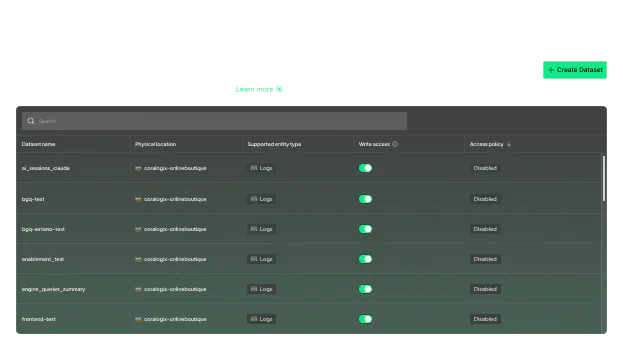
• A Dataset is a governed collection inside it, with its own schema, access, retention, and cost tracking.
Data lands in the default dataspace. Route data to user made dataset, segment data by team, service, or any use-case; use the system Dataspace to query platform telemetry like alerts, schema health, audits, and more.
Performance
Scoped data, faster everything
Scoped datasets mean faster queries and lighter dashboards. Streaming datasets isolate noisy data. Summary datasets turn heavy queries into persistent assets that load instantly.
Governance
Shape data to match your org
User-defined named datasets that reflect your org structure. Each is self-describing with its own schema, access, and retention. System datasets surface platform health, audits, and usage automatically.
Routing
Route by any field, any logic
Route any field with granular DataPrime expressions in TCO, or programmatically with writeTo. Fan out logs to multiple datasets when compliance and operations need different views.
Cost control
Know what every team costs
Per-dataset attribution with daily breakdowns and enforceable quotas. Know exactly what each team generates. Scoped data also means fewer tokens per AI query.
AI-native
Architecture that makes agents smarter
Scoped context means agents reason precisely instead of guessing. Clean schemas reduce hallucination. Governed access controls what agents reach. Pre-aggregated data cuts token cost.
One architecture. Many uses
Give every team its own governed data lane
Create named datasets that match the way your org works - by team, service, or any use-case. Route data in with granular DataPrime expressions or programmatically with writeTo. Each dataset gets its own schema, access, and retention.
- Route by any field, any condition
- Fan-out to multiple governed datasets
- Self-describing, collision-free schemas per team
Run the heavy query once. Dashboards stay instant.
Automatically write background query results into persistent datasets. Reuse them in Explore, Dashboards, and APIs indefinitely. Terabytes of raw logs become megabytes of summary. Multiple queries can write to the same dataset, compounding analytical value.
- Persistent results, queryable anywhere
- Append or overwrite with versioning
- Splunk summary index replacement, native
Your platform's behavior as queryable data
The system dataspace tracks platform activity with datasets that cover query performance, schema health, alerts, usage, audit trails, and more - all queryable with DataPrime. Agents can reason about the platform itself, not just your applications.
- 7+ live datasets, queryable today
- Query Performance Dashboard built-in
- Platform intelligence for agents and admins
Read more about Dataspaces and Datasets
Monitor schema health with engine.schema_fields: Structure, Drift, and Volatility
If you’ve worked with an observability pipeline, you’ve probably experienced schema problems: a field disappears,...
From Alert Fatigue to Optimized Notifications with System Datasets
Alert fatigue rarely begins as a single mistake. It grows as systems scale, teams grow,...
Introducing System Datasets: Observing the Observability Platform
Modern observability platforms are great at explaining what’s happening in your apps and your infrastructure....
