Why should you demand OpAMP support from your vendor?


Fleet management is the practice of monitoring and configuring your fleet of agents and collectors. Key functionality includes:
- Pushing configuration to agents via a central interface
- Management of configurations across multiple versions
- Monitoring the health and performance of collectors
Fleet management is the hallmark of an organisation that has realised the great importance of a healthy telemetry pipeline, and has taken steps to ensure that collectors & agents are every bit as robust as the production architecture for which they are responsible. At Coralogix, we offer OpAMP based fleet management (more on what this is below!), that ensures customers have a pure open source experience with all the convenience of SaaS.
How does OpenTelemetry make this possible?
OpenTelemetry has a specific protocol for the management of collector configuration, and the publishing of health metrics. This protocol is the OpenTelemetry Agent Management Protocol, often referred to as OpAMP.
OpAMP has two communication modes – gRPC websockets or HTTPS, and while young, is becoming the de facto standard for fleet management. Protocol flexibility means that OpAMP will work in most environments.
Other vendors offer their own implementations, although it is worth mentioning that vendor-specific solutions can carry a certain amount of vendor lock-in, even if they’re variants of OpenTelemetry.
OpAMP is platform-agnostic by design, with implementations available for Linux, macOS, and Windows across common architectures. There are no hard OS limitations. If your environment supports HTTPS or WebSocket communication, OpAMP will run. This flexibility ensures consistent collector management, whether you’re operating in containers, virtual machines, or traditional hosts.
Why should you insist on OpenTelemetry-based fleet management?
There are a number of trends happening in the industry today. Almost half of surveyed companies reported using OpenTelemetry, with a further 25% declaring concrete plans for a migration. However, OpenTelemetry is not just a convenient standard around which to coalesce. It has a much more important role in combating one of the worst aspects of the observability industry. Many legacy vendors in the observability space existed before convincing open source tooling existed for collection. To combat this, they built their own solutions, as we often do as engineers. In time, however, OpenTelemetry has emerged as the standard, and many of these vendors are yet to fully support it.
This creates a danger for vendor lock-in, where customers and companies find themselves unwillingly married to a particular vendor, due to the depth and complexity of the technical integration. This has driven mistrust and uncertainty in many organizations, who are unsure whether the power of an O11y vendor is worth the risk of vendor lock-in.
OpenTelemetry is your middleware
Fleet management is an especially important part of your telemetry pipeline’s lifecycle. It ensures central control over your resources, and identifies issues with throughput and flow of telemetry. By using OpenTelemetry collectors, and leveraging the OpAMP protocol, you’re ensuring that this crucial part of your operational toolkit is not hijacked by vendors seeking to build a closed garden around your infrastructure.
Closed-garden observability is a thing of the past and at Coralogix, we’re focused on the future of observability. That future is defined by open source integrations, protecting customers, while the convenience and scalability of well-architected SaaS brings immediate time to value and convenience that modern SREs and engineers need to solve the problems of today.
Coralogix is committed to keeping your options open
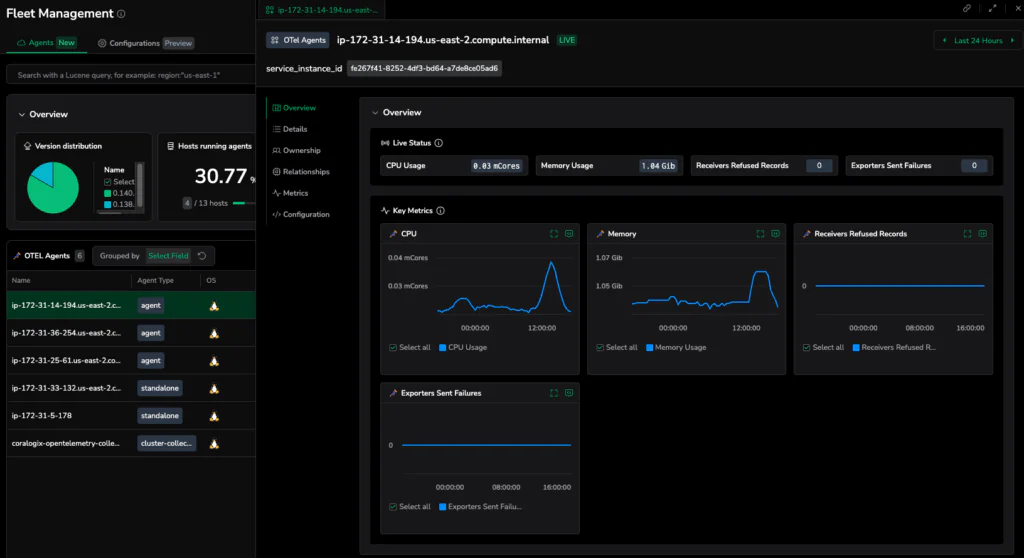
Coralogix fleet management is a fully featured solution for tracking, configuring and diagnosing issues with your fleet of OpenTelemetry collectors. We track everything, from flow rates, collector uptime, failed sends, resource consumption and current configuration. Combined, these give a clear picture of your telemetry pipeline and ensure your telemetry infrastructure is just as efficient, reliable and scalable as your production stack.
To find out more, check out our documentation and book a demo with our sales teams.