Spending More, Seeing Less: How Indexing Limits Capital Markets Visibility

Capital markets systems don’t scale linearly. A macro event, an earnings release, a sudden liquidity shift, and telemetry volume doubles in seconds.
In most observability platforms today, that spike means one thing: every byte gets written to a high-cost index before a single query can touch it. There’s no middle ground. You pay full indexing cost for the compliance log that no one queries for six months, the same way you pay for the execution trace you need right now. And when you want that six-month-old compliance record? Rehydration. Another bill. Another wait.
In high-volume environments, indexing-heavy models don’t just become expensive; they actively limit visibility, slow investigations, and force trade-offs between performance, compliance, and cost. And in capital markets, trade-offs like that don’t hold.
The firms that have moved past this model aren’t just spending less. They’re seeing more.
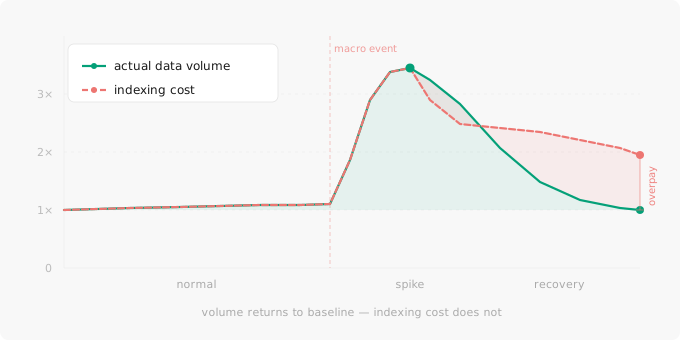
Indexing assumes stable data. Markets don’t.
Traditional observability is built around a simple assumption: index everything up front, query it later. That model holds in stable environments, but capital markets environments are not stable.
Index-based systems have two responses: throttle ingestion, or absorb the cost. Neither works when missing data means missed trades and incomplete records mean failed audits.
Indexing forces a choice: visibility versus cost. In trading, it’s impossible to predict which 0.1% of events will matter. Latency issues, execution drift, routing anomalies show up in edge cases, not in aggregated data. If those events weren’t indexed, they don’t exist. In regulated banking environments, the trade-off is harsher: index everything and absorb the cost, or don’t and accept audit risk.
And then comes the dreaded rehydration tax: pulling archived data back into an index just to answer a question you couldn’t afford to keep searchable in the first place. The indexing bill is expected. The rehydration bill is the one that arrives when it’s least convenient.
What a different architecture looks like in practice
Coralogix processes all telemetry through a single in-stream pipeline before any routing decision is made. Every event is parsed, enriched, and classified while it’s still in motion. That classification determines what happens next: where data goes, how it’s stored, and what it costs. Nothing is indexed by default. Everything is queryable on demand.
Three capabilities make this concrete for capital markets teams:
Remote query: The end of the rehydration tax
Direct query against your own cloud storage without rehydration, cold-start delay, or separate billing event. Compliance logs from six months ago query at the same speed as yesterday’s execution traces. Unlimited retention with zero penalty for accessing it.
- Instant archive access: Query six months of execution logs or compliance records in seconds. When a regulator asks for incident history or a client disputes a trade, the answer is seconds away.
- Full data ownership: All telemetry stays in your own cloud storage, in your chosen region, in open-standard Parquet format. No vendor lock-in, no data residency risk, which matters when MiFID II, DORA, and GDPR all have opinions about where your data lives.
- Query flexibility: Run aggregations, redactions, and dynamic filtering against historical data using whichever syntax your team works in. Post-trade analysis, capacity planning across volatility windows, and compliance audit checks all run against the same archive.
TCO optimizer: Data tiering by value
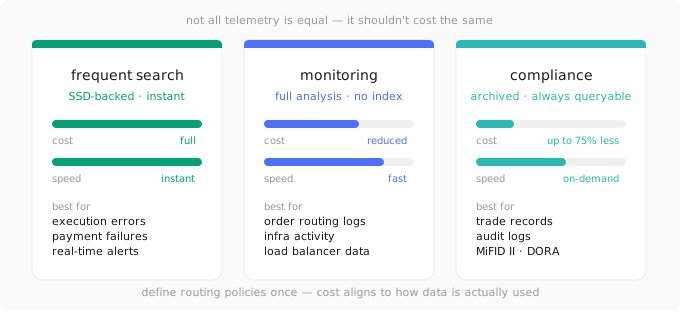
Not all telemetry is equal, and it shouldn’t cost the same. The TCO Optimizer lets you define routing policies that direct each data type to one of three tiers based on how you actually use it.
Data engine: shape data before it becomes cost
Coralogix’s data engine processes telemetry in-stream, before routing and before storage. Normalization, enrichment, pattern detection, and metric extraction all happen while the data is still in motion. What reaches storage is already clean, contextualized, and shaped to the way your teams actually query it. This means less storage consumed, lower query costs, and faster investigations from the moment data lands.
- Parsing rules: Transform unstructured execution logs, FIX message streams, and market data feeds into consistent, normalized fields. Searching, aggregating, and troubleshooting work cleanly across teams.
- Data enrichment: Attach business and operational context to every signal on arrival, including counterparty identifiers, security classifications, cloud tags, custom lookup data.
- Events2metrics: Convert high-volume execution logs into long-term metrics, like P95 and P99 latency across pricing engines, fill rate tracking by venue, order rejection rates by instrument. Raw signals become usable, contextual data.
- Log templating: ML groups billions of logs into recurring templates in real time. After a deployment to your order management or risk engine, new error patterns surface immediately.
The architecture is the argument
Most observability conversations focus on features like faster queries, better dashboards, smarter alerts. But in capital markets, those aren’t the limiting factors. The model is.
When observability is built on indexing everything, cost and visibility are permanently at odds. You either control spend and lose fidelity, or keep full fidelity and lose control of cost. No amount of optimization fixes that, because the constraint is built into how the system works.
What changes outcomes isn’t better indexing. It’s removing the dependency on indexing altogether.
That’s the shift Coralogix represents. Modernize your observability stack with Coralogix.